
The Story Behind Artisan-Made Sewing Tools: Part 2

Some sewing tools support the work quietly in the background.
They sit beside us on the table, hold what we need close at hand, and make small movements feel easier and smoother. But even these practical objects can carry a remarkable amount of story.
At Itoma, we are drawn to tools that do more than solve a problem. We love objects that feel thoughtful in the hand, beautiful on a work surface, and connected to places, materials, and makers. In Japan, even a pincushion or a thread snip can hold traces of regional craft, long-practiced skill, and a deep respect for everyday use.
For this second part, we wanted to share three tools that bring together utility and character in different ways. One helps organize the workspace with calm efficiency, one transforms a traditional folk form into something charming and useful, and one turns a cutting tool into a meeting point between steel and silk.
Hasami Magnetic Pin Holder
A small ceramic tool that keeps the workspace calm
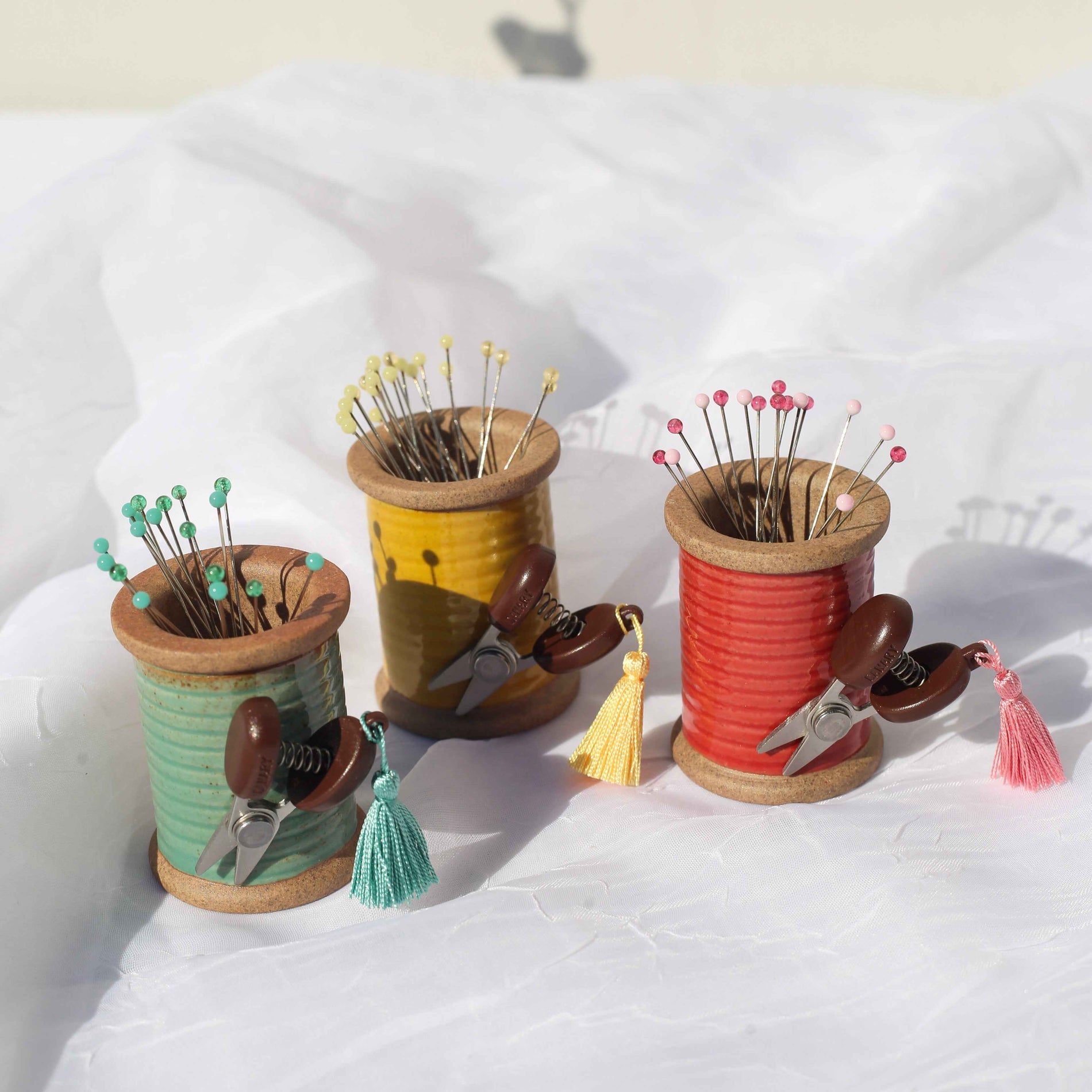
At first glance, the Hasami Magnetic Pin Holder looks almost like a spool of thread translated into ceramic form. Its shape is familiar, but its function is quietly clever.

Made in Nagasaki, this spool-shaped holder contains a strong built-in magnet that neatly stores pins, needles, and even small metal objects like paperclips. It is designed so that needles can stand upright, making them easier to insert and remove with one hand than with a conventional fabric pincushion. Inside, soft felt protects the needles from direct contact with the ceramic base, while the magnet also makes it easy to pick up dropped pins directly from the work surface.

The product story notes that its low-temperature firing gives it a luster and texture reminiscent of ancient pottery, while the colorful glaze makes it resemble a real spool of thread. It can even hold Cohana’s Seki Mini Scissors along the side, turning it into a compact little workstation of its own.
What makes this piece so appealing is the balance between usefulness and atmosphere. It does not ask for attention loudly, but it changes the feeling of the table around it. It keeps small tools in order, makes repetitive motions smoother, and brings a soft visual rhythm to the workspace at the same time.
It feels like a reminder that organization can be beautiful too.
→ Check Hasami Magnetic Pin Holder
Kokeshi Doll Pincushion
A traditional form, opened into something playful and useful
Some tools feel practical first. Others make you smile before you even begin.
The Kokeshi Doll Pincushion belongs to the second kind.
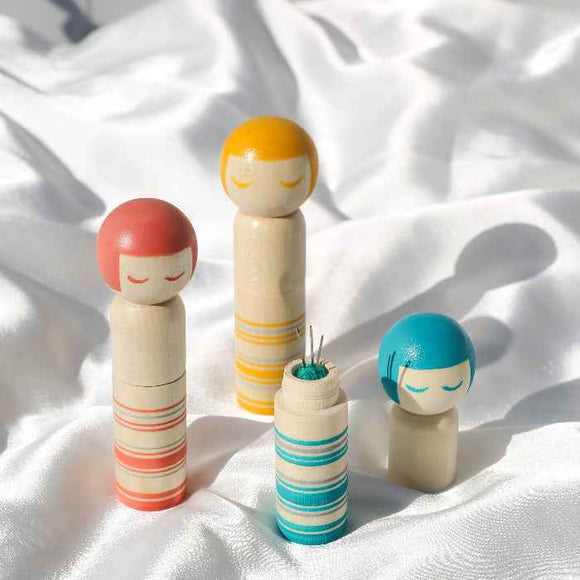
This charming object is based on the traditional kokeshi dolls of northern Japan. According to the product story, woodworkers in snowy Tsugaru began carving these small dolls as souvenirs for visitors to the region’s hot springs. Cohana collaborated with the Tsugaru Kokeshi Museum in Kuroishi City, Aomori, the birthplace of Tsugaru Kokeshi, to create a modern and functional interpretation of that tradition. The doll keeps the sleek shape and bobbed hair associated with Tsugaru Kokeshi, but opens to reveal a hidden pincushion inside.

Each one includes three needles from Meboso Hachirobei Shoten, and the magnetic base can pick up fallen pins and needles with ease. Each doll is hand-painted, so there are small differences in expression from one piece to another.

What we love about this object is the way it carries both memory and surprise. It begins as a familiar cultural form, then becomes part of the making process in a new way. It is useful, of course, but it also brings personality to the sewing corner.
Rather than reducing a traditional object into decoration alone, it gives it a new role in everyday life. That quiet shift feels very meaningful. A tool like this does not only help hold needles. It also changes the mood of the space, making it feel warmer, a little more human, and a little more alive.
→ Check Kokeshi Doll Pincushion
Shozaburo Thread Snips with Iga Silk Braid
Where sharp steel meets the softness of handwoven silk
Thread snips are among the most frequently used tools in sewing and embroidery, which is perhaps why it feels so special when one is made with exceptional care.

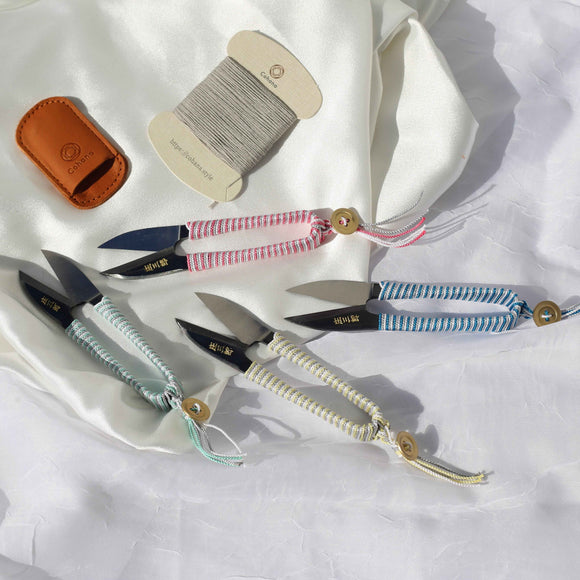
These Shozaburo Thread Snips are crafted in Tokyo by artisans who make each pair one at a time with a strong commitment to quality. The product story explains that Shozaburo scissors are rooted in techniques adapted from the forging methods of Japanese swords in the Edo period, and that these time-honored methods remain part of the company’s work today.

The steel body is paired with handles wrapped in Iga silk braid, or kumihimo, a craft that has been made in the Iga region for more than 1,300 years and was once used in samurai armor.
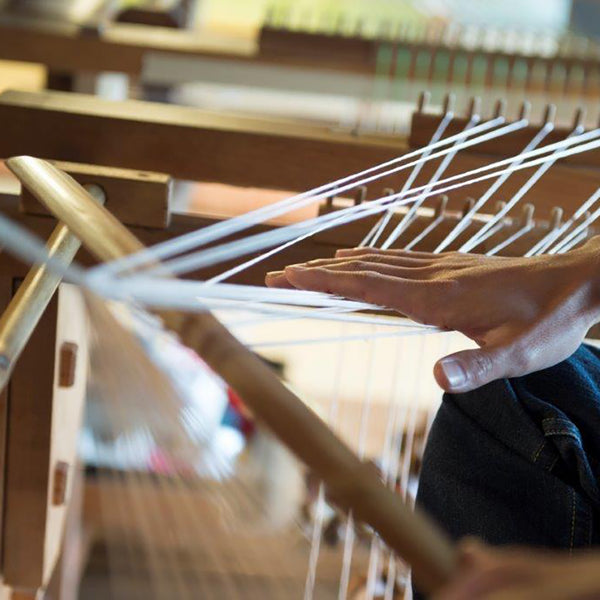
At Matsushima Kumihimo-ten in Iga, silk threads are wound and woven by hand, then wrapped around the snips to bring color, softness, and a distinct luster to the steel tool. The result is a pair of snips that is not only precise and long-lasting, but also gentle in the hand and visually striking.
What feels most beautiful here is the meeting of two very different material worlds. Steel gives the tool its precision and strength. Silk gives it warmth, texture, and an almost ceremonial presence. Together, they make something that feels more personal than an ordinary cutting tool.
It is easy to imagine these snips becoming one of those objects that stays nearby for years, not only because they work well, but because using them continues to feel good.
→ Check Shozaburo Thread Snips with Iga Silk Braid
More Than Utility
What ties these three tools together is not only craftsmanship, but the way they enrich the small gestures of making.
A magnetic holder changes how we reach for a pin.
A kokeshi doll changes how a sewing corner feels.
A pair of thread snips changes the rhythm of a hand in motion.
None of these objects are large. None ask to be the center of attention. And yet each one brings something lasting into the making process: ease, beauty, personality, and a sense of connection to the places and makers behind it.
At Itoma, we love sharing tools like these because they remind us that craft is shaped not only by what we make, but also by what we make with. A good tool supports the work. A thoughtful tool can also deepen the experience of it.
We hope this second part helps you discover a few more of the quiet stories held inside everyday sewing tools.
— Itoma


